















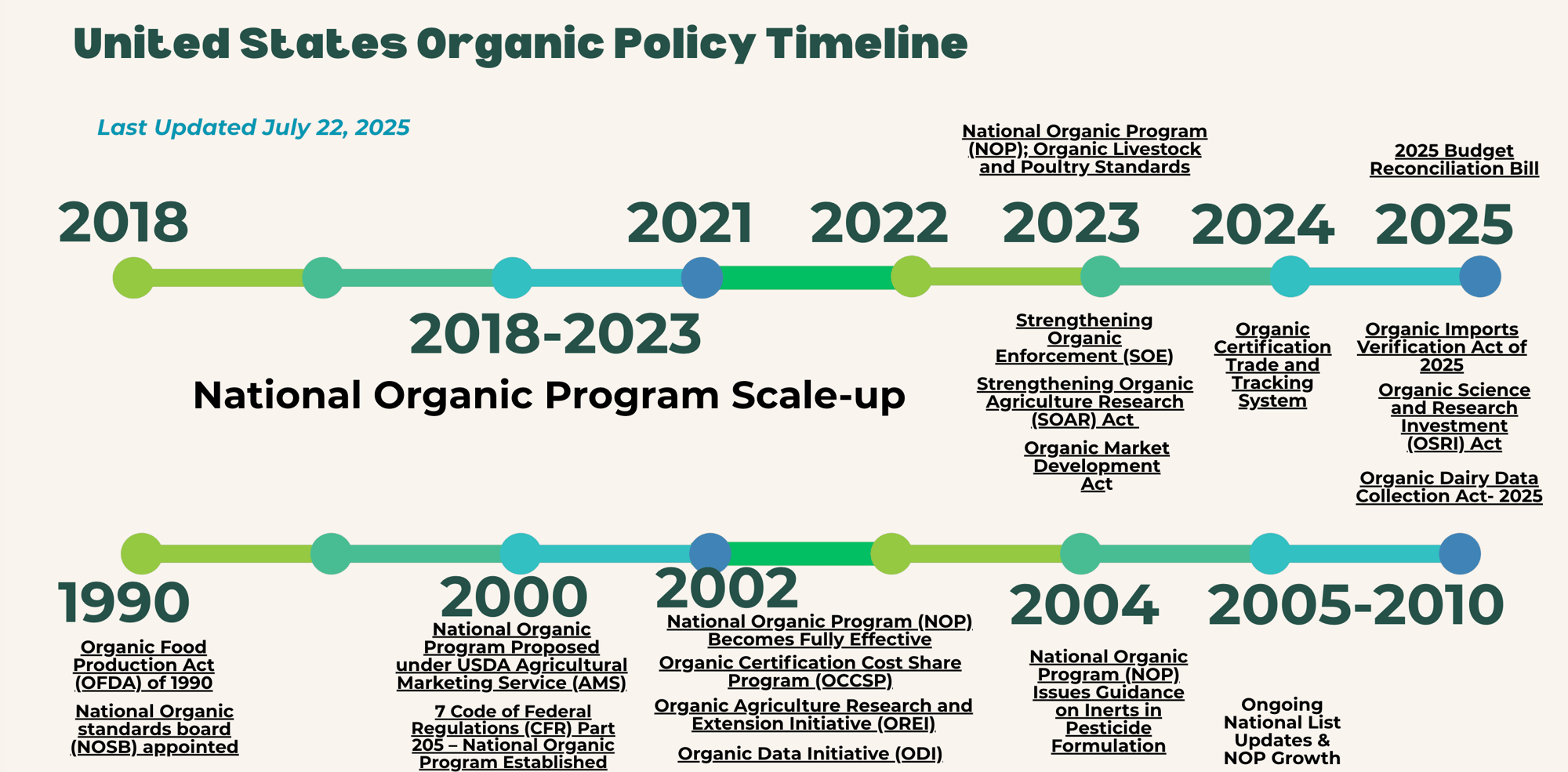
Organic Foods Production Act of 1990 (OFPA)
The Organic Foods Production Act of 1990 (OFPA) is a federal law that established national standards for the production,
handling, processing, and labeling of organic agricultural products in the United States. Its goal was to standardize the definition
of "organic," reduce consumer confusion, and ensure that all products marketed as organic meet consistent requirements
nationwide
National Organic Standards Board (NOSB)
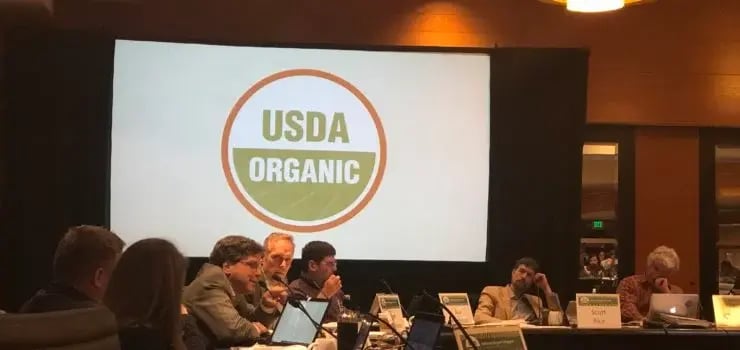
The National Organic Standards Board (NOSB) was established under the Organic Foods Production Act of 1990 and is
governed by 7 U.S. Code § 6518. The Secretary of Agriculture appoints the NOSB members, who serve staggered five-year
terms with no consecutive terms allowed unless the original term was less than five years1. The Board consists of 15 members
representing diverse sectors of the organic community, including organic farmers, handlers, environmentalists, retailers,
certifying agents, and consumer/public interest group.
7 Code of Federal Regulations (CFR) Part 205 – National Organic Program Established
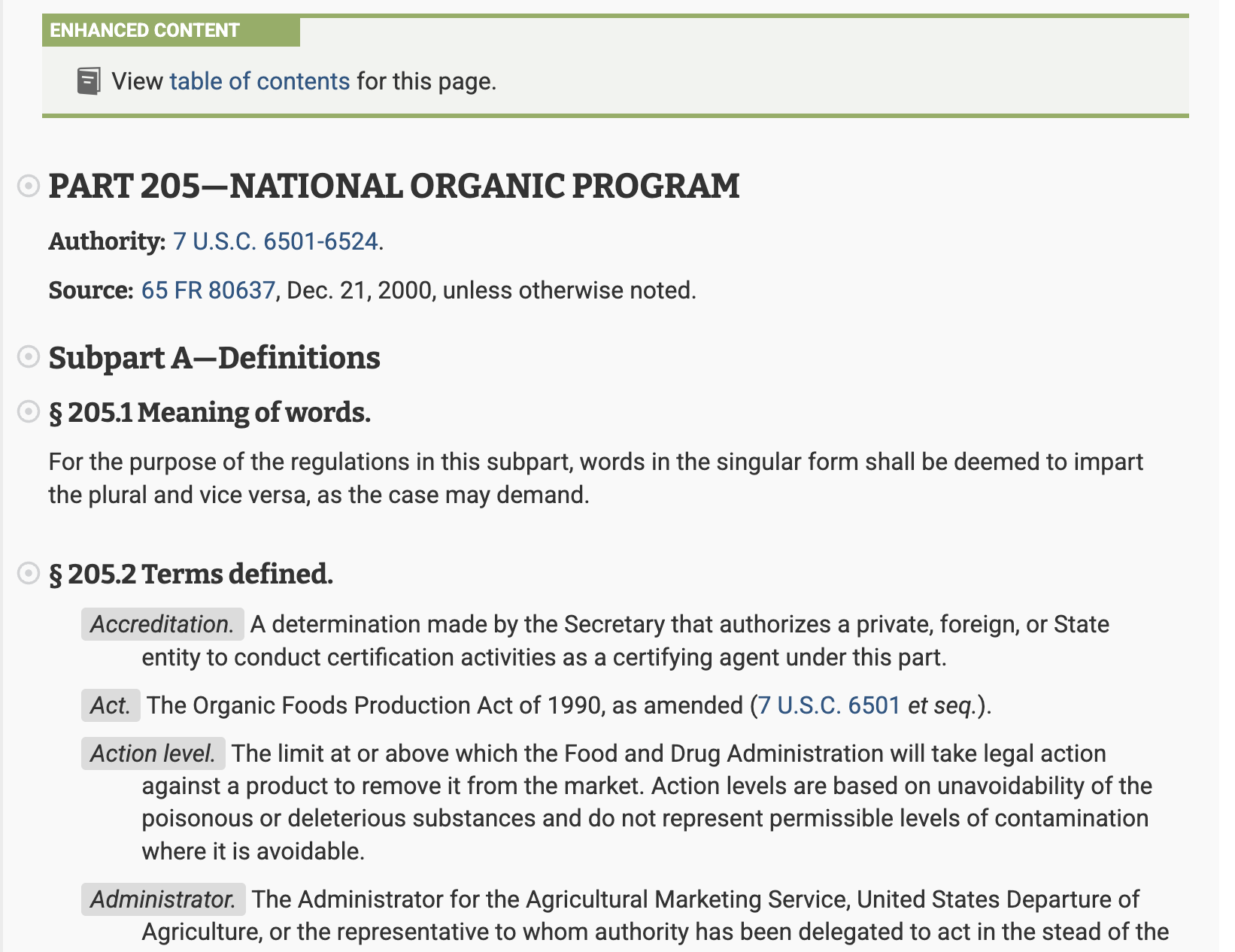
7 CFR Part 205 – National Organic Program, established in 2000, is the federal regulation that sets forth the national standards for the production, handling, certification, and labeling of organic agricultural products in the United States. This regulation was published on December 21, 2000 and implements the Organic Foods Production Act of 1990, providing uniform requirements for organic operations and certifying agents to ensure the integrity of organic claims.
National Organic Program Proposed within USDA Agricultural Marketing Service
In 2000, the National Organic Program (NOP) was formally proposed and initiated by the USDA’s Agricultural Marketing Service
(AMS) to establish a mandatory national organic certification program with consistent, uniform standards for organic agricultural production and handling across the U.S. This followed the Organic Foods Production Act of 1990, which had required the USDA to develop these standards but delayed final regulations for nearly a decade.
Organic Data Initiative (ODI)
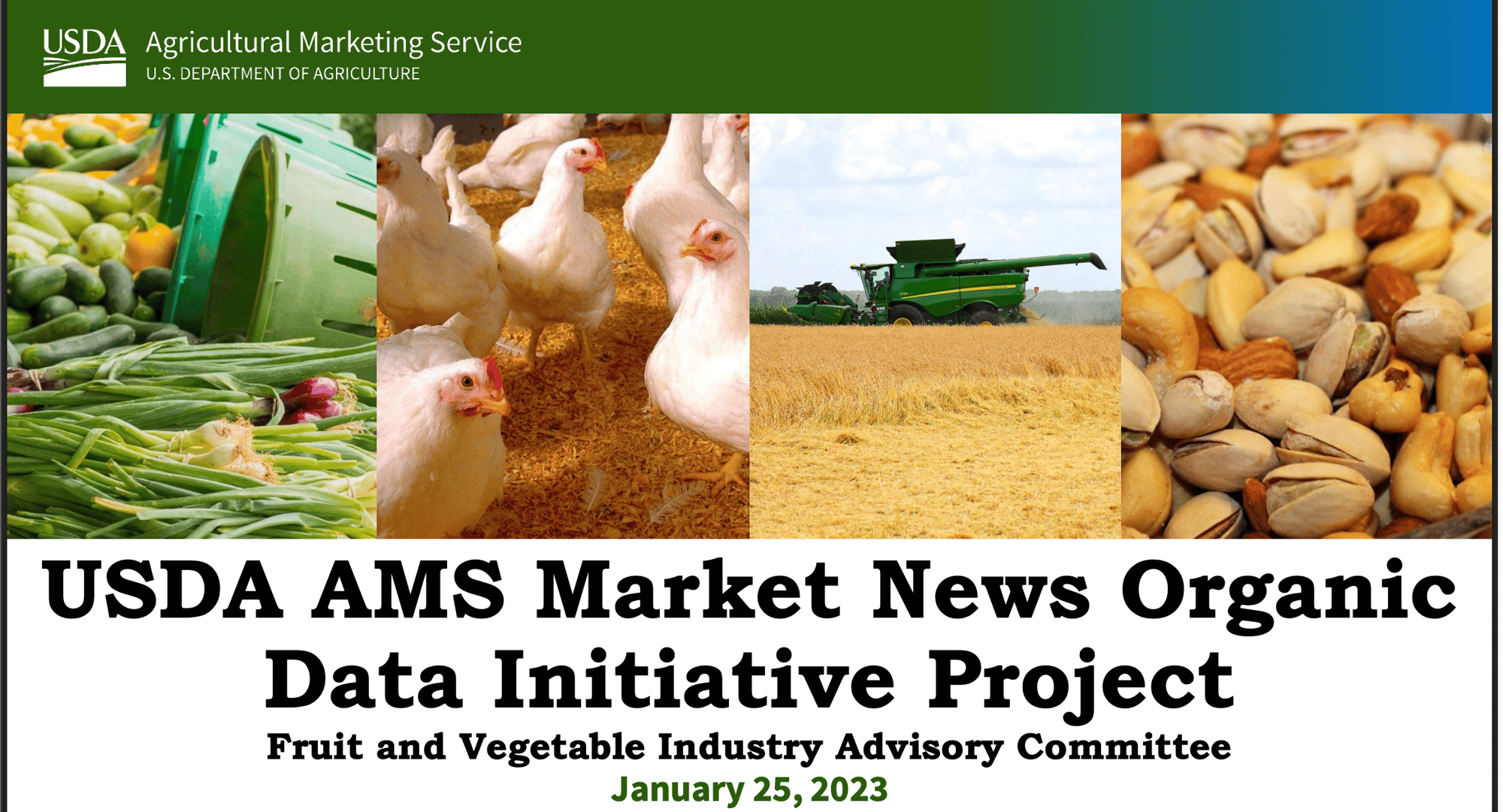
The Organic Data Initiative (ODI), authorized by the 2002 Farm Bill and funded with $5 million starting in the 2008 Farm Bill, is a USDA AMS program to improve collection and analysis of data on organic agricultural products. ODI gathers price and volume data on over 200 organic commodities, conducts comprehensive surveys across production and distribution, and publishes reports to support stable markets and informed decision-making. The 2018 Farm Bill allocated $3.5 million to expand market reporting, enhance data systems like the Market Analysis and Reporting System (MARS), and boost data visualization and collaborations with universities and extension services. ODI now offers extensive, free organic market data—including dairy, livestock, grains, and specialty crops—via MyMarketNews.gov, and continues to add new data sources and tools to strengthen transparency and support organic sector growth.

Organic Agriculture Research and Extension Initiative (OREI)
USDA programs dedicated to organic research, education, and extension provide targeted resources and technical assistance to organic producers. These programs are central to developing new organic practices, sharing information, and fostering innovation in the organic sector. The Organic Research, Education, and Extension Programs were first funded through the Organic Agriculture Research and Extension Initiative (OREI), which was established by the 2002 Farm Bill with an initial mandatory funding of $15 million over five years (about $3 million annually). Funding increased significantly with the 2008 Farm Bill to $78 million over four years (about $20 million per year). Permanent mandatory funding was secured in the 2018 Farm Bill, starting at $20 million annually in FY 2019 and ramping up to $50 million by FY 2023, ensuring ongoing support for organic research, education, and extension activities to address the challenges of organic agriculture. As of 2024 and 2025, OREI continues to be actively funded, with approximately $44 million available each year for grants through USDA's National Institute of Food and Agriculture (NIFA).
Organic Certification Cost Share Program (OCCSP)
The Organic Certification Cost Share Program (OCCSP), established under the 2002 Farm Bill and currently administered by USDA’s Farm Service Agency (FSA), helps organic producers and handlers reduce the financial burden of organic certification by reimbursing up to 75% of certification costs, with a maximum payment of $750 per certification scope annually. Initially managed by the Agricultural Marketing Service, administration shifted to FSA to broaden access through its county offices. The program covers expenses such as application fees, inspection costs, and related certification charges.
National Organic Program (NOP) Becomes Fully Effective
The National Organic Program (NOP) regulations became fully effective on October 21, 2002. On this date, all organic products
sold in the United States were required to comply with the standards established under the Organic Foods Production Act of 1990
and implemented through the NOP final rule. This milestone marked the official federal enforcement of uniform national standards
for organic production, handling, processing, and labeling. The USDA Organic Seal could also officially be used starting on this date,
signifying compliance with NOP standards.
National Organic Program (NOP) Issues Guidance on Inerts in Pesticide Formulation
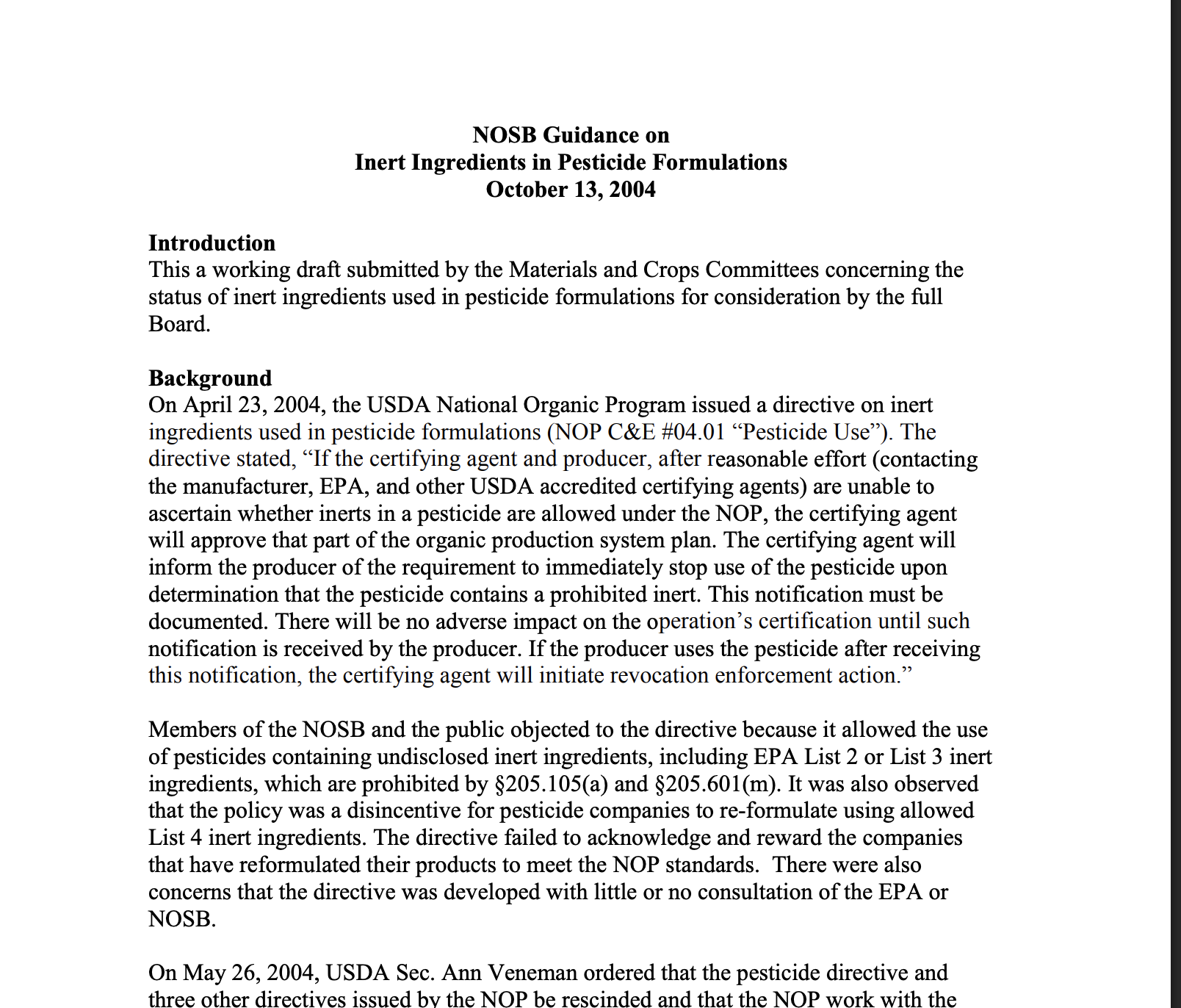
In 2004, the USDA National Organic Program (NOP) issued guidance regarding inert ingredients in pesticide formulations used in organic production—specifically through the directive NOP C&E #04.01 (“Pesticide Use”). This guidance acknowledged that many pesticide formulations contain inert ingredients that may include substances prohibited by the National Organic Program regulations. The directive stated that if producers and certifying agents could not determine whether inert ingredients were
allowed after reasonable efforts (contacting manufacturers, EPA, and others), certifiers would initially approve pesticide use. However, if later it was found that the pesticide contained prohibited inert ingredients, producers had to immediately stop use, or face enforcement and certification revocation.
Ongoing National List Updates & National Organic Program (NOP) Growth
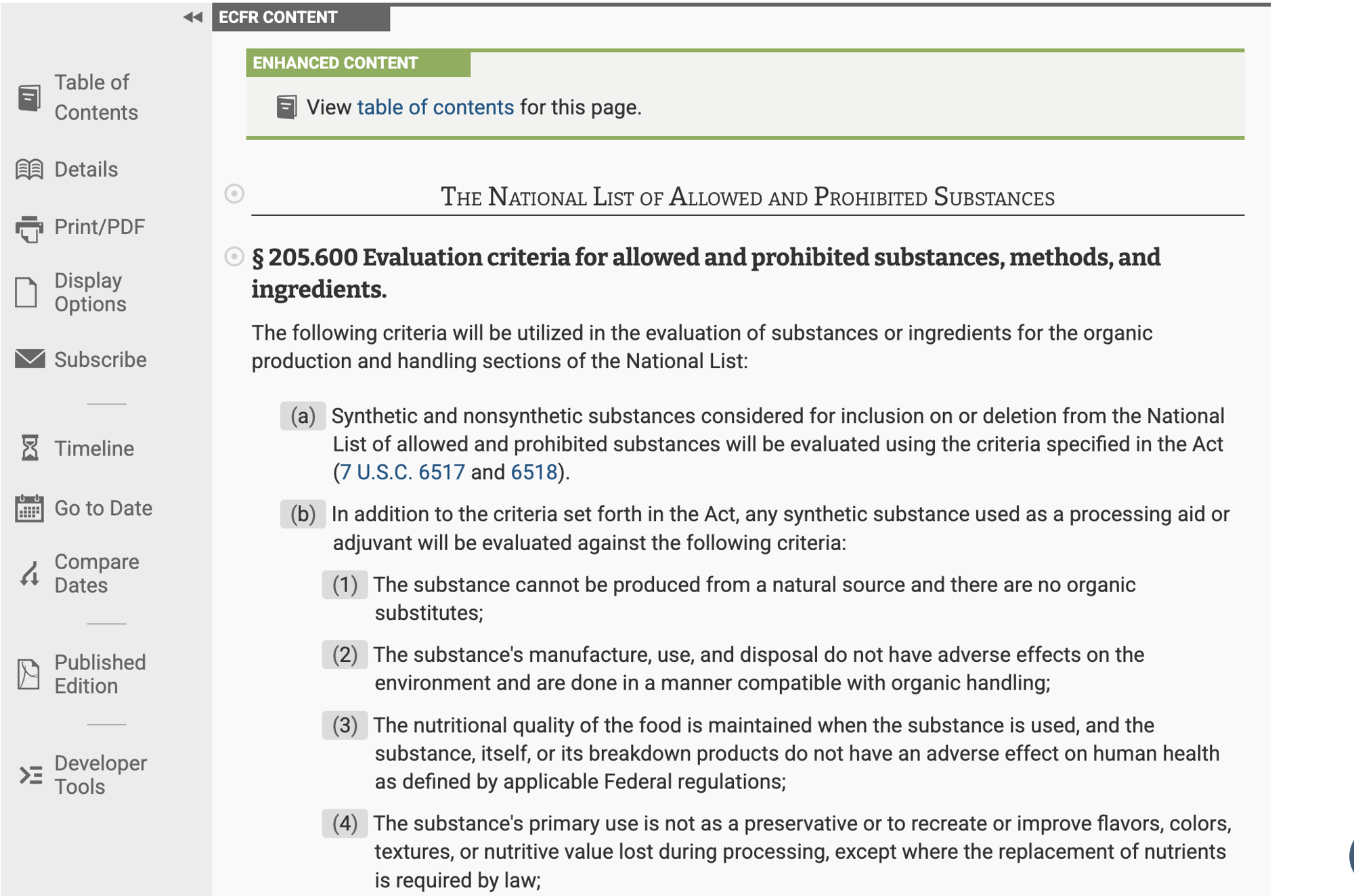
Between 2005 and 2010, the National Organic Program (NOP) experienced significant growth and refinement, particularly through ongoing updates to the National List of Allowed and Prohibited Substances. During this period, the sunset review process was the primary method for revisiting substances on the National List, ensuring that every five years each substance was thoroughly evaluated for continued compliance with organic standards based on health, environmental impact, and availability of alternatives. The National Organic Standards Board (NOSB) played a central role by reviewing petitions,
conducting technical assessments, and making recommendations to either renew, amend, or remove substances. Changes to
the List required USDA rulemaking with public comment, resulting in a rigorous and transparent process that balanced
stability for organic producers with integrity in organic production. This period also saw increased numbers of certified
operations and certifying agents, reflecting the expansion of the organic sector and the growing role of the NOP in
administering consistent, science-based standards nationwide
National Organic Program Scale-up
From 2018 to 2023, the National Organic Program (NOP) significantly scaled up both its operational capacity and the organic
industry it regulates. The size of the NOP staff grew from fewer than 12 employees in 2008 to approximately 82 by early 2023,
fueled by increased congressional appropriations starting in 2018. This growth enabled NOP to enhance critical functions such as managing the Organic Integrity Database, accrediting certifying agents, updating the National List of Allowed and Prohibited Substances, developing regulations, conducting trainings, and enforcing organic standards with greater rigor.

Livestock & Poultry Production Standards Developed
In November 2023, the USDA’s Agricultural Marketing Service (AMS) finalized important amendments to the National Organic Program (NOP) regulations governing organic livestock and poultry production (published November 2, 2023). This final rule updated organic standards to promote consistent animal welfare practices and clarify livestock care, living conditions, transportation, and slaughter requirements across mammalian and avian species. Key changes include prohibitions on certain physical alterations (like beak trimming and tail docking), enhanced health care practices, specified indoor and outdoor space requirements for poultry, and detailed rules for humane transport and slaughter processes. The rule also reinforces that organic animals treated with prohibited substances must be removed from organic status and clarifies the handling of milk from treated
dairy animals during withdrawal periods.
Organic Market Development Act
The Organic Market Development Act, introduced in 2023, aims to permanently establish and expand USDA’s Organic Market Development Grant Program to address supply chain gaps and strengthen domestic organic markets. Building on an initial $75 million investment, it authorizes an additional $25 million annually starting in 2024 to support infrastructure improvements, processing, storage, business development, and consumer education that enhance organic production capacity and market
access. The Act seeks to help more U.S. producers benefit from growing consumer demand by modernizing supply chains and expanding market opportunities. As of mid-2025, the legislation remains under consideration in Congress, while USDA continues to fund and administer grants supporting organic market growth.
%20Act.jpg?width=720&height=381&name=trengthening%20Organic%20Agriculture%20Research%20(SOAR)%20Act.jpg)
Strengthening Organic Agriculture Research (SOAR) Act
The Strengthening Organic Agriculture Research (SOAR) Act is designed to ensure consistent and robust funding for organic research by amending the farm bill to boost investments in the USDA’s Organic Agriculture Research and Extension Initiative (OREI). This act addresses the research needs of organic producers by increasing the resources available for applied and regionally relevant research,
education, and extension activities that help advance organic agriculture in the United States.
The SOAR Act was introduced in 2023 and aims to increase funding and support for organic agricultural research. It proposes stepped budget increases for the Organic Research and Extension Initiative (OREI), from $60 million in 2024 to $100 million by 2028, first-time congressional authorization and funding for the Researching the Transition to Organic Program (RTOP), and increased support for the Organic Production and Market Data Initiative (ODI). The SOAR Act was actively supported by organic farming organizations and introduced by members of the House Agriculture Committee in 2023, with companion legislation expected in the Senate.
Strengthening Organic Enforcement (SOE)
The Strengthening Organic Enforcement (SOE) rule, finalized by the USDA on January 18, 2023, and fully implemented as of March 19, 2024, represents the most substantial update to organic regulations since the creation of the National Organic Program in 1990. Mandated by the 2018 Farm Bill and informed by recommendations from the National Organic Standards Board, this rule enhances oversight of the organic supply chain to better prevent fraud, protect organic integrity, and improve transparency. Key provisions include expanding organic certification requirements to previously exempt handlers such as brokers and traders, requiring electronic import certificates for all organic imports, increasing the frequency and rigor of unannounced inspections, and standardizing enforcement tools and documentation across certifiers. It also mandates improved recordkeeping, traceability, and
fraud prevention systems throughout the organic supply chain. Rather than being a standalone act of legislation, the SOE was
implemented as a USDA regulatory rule and is fully enacted and funded through regular National Organic Program operations, with continued USDA support to ensure compliance and strengthen trust in the USDA Organic label.
%20i.webp?width=1280&height=720&name=Electronic%20Code%20of%20Federal%20Regulations%20(e-CFR)%20i.webp)
Establishment of e-CFR
The Electronic Code of Federal Regulations (e-CFR) is a continuously updated online version of the CFR, offering faster access to current federal regulations than the annually published print edition. Though unofficial, it integrates updates from the Federal Register within days and features user-friendly search and navigation tools. In 2023, the e-CFR strengthened its role as the primary digital resource for regulatory information, meeting the growing demand for accessible, real-time legal content. It is maintained by the Office of the Federal Register and the Government Publishing Office.
Organic Certification Trade and Tracking System
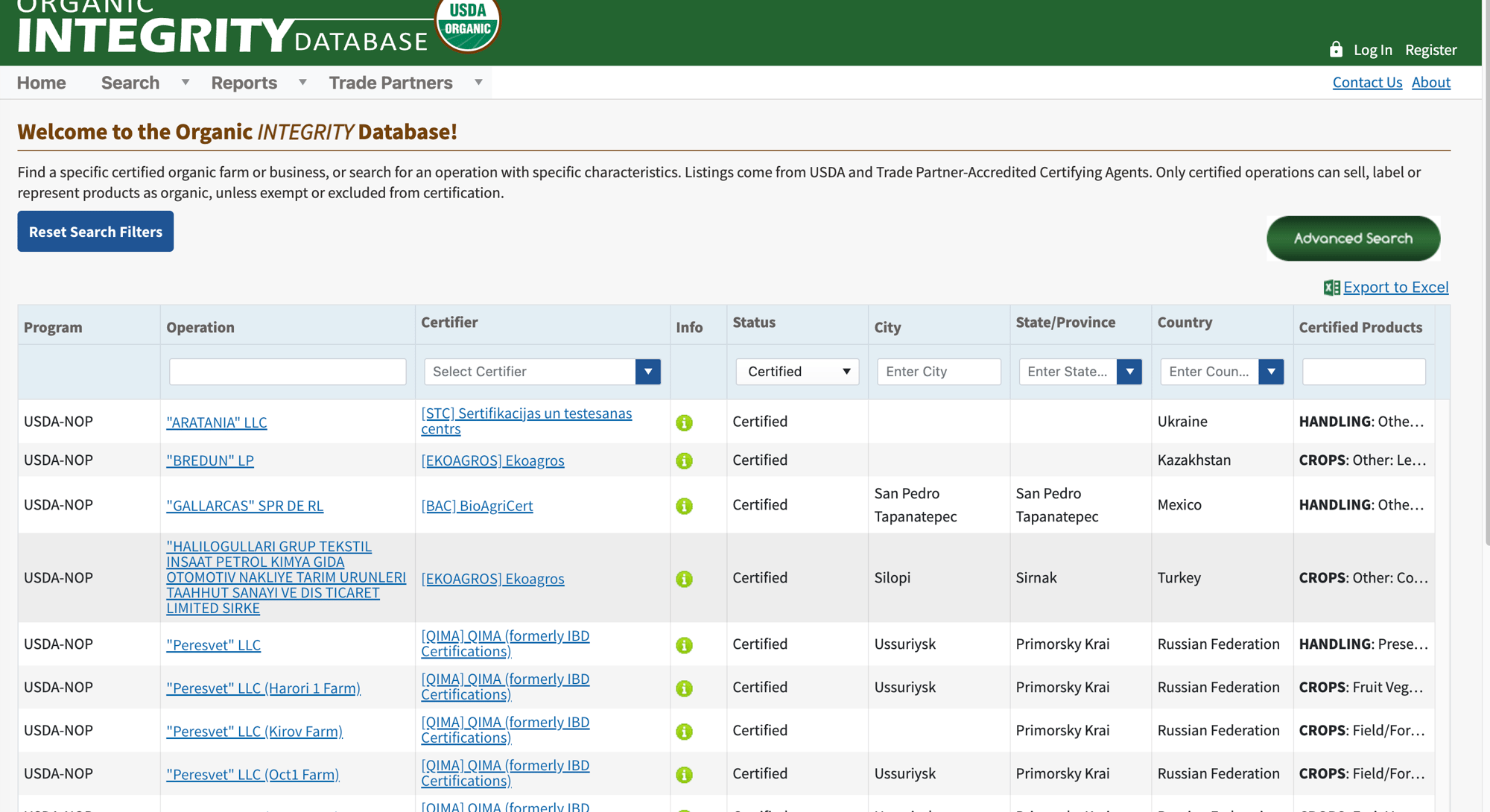
The Organic Certification Trade and Tracking System (OCTT) is a USDA-managed platform that ensures the integrity and traceability of organic products in international trade by issuing and verifying electronic import/export certificates. It enforces expanded certification requirements for all parties in the organic supply chain—including importers, exporters, and brokers—and tracks compliance with strengthened organic standards, audits, and residue testing. OCTT also supports equivalence agreements to streamline cross-border organic trade while maintaining rigorous audit trails to detect fraud and uphold consumer confidence in organic labels worldwide.
Organic Dairy Data Collection Act- 2025
Not enacted or funded
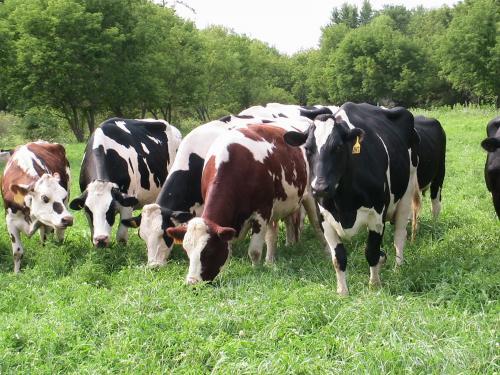
This 2025 bill supports mandatory data collection on organic dairy, aiming to improve transparency, pricing, and market access for organic dairy producers. The act is designed to address gaps in market data that have long challenged organic dairy operations.
Organic Science and Research Investment (OSRI)
Not enacted or funded--The Organic Science and Research Investment (OSRI) Act was reintroduced in 2025 by Senators John Fetterman and Adam Schiff to significantly expand federal support for organic agricultural research. This legislation seeks to increase long-term investment in organic-specific science through the USDA, improve farmer access to regionally relevant organic production methods, and bolster data collection on organic practices. At its core, the OSRI Act aims to strengthen the economic sustainability and competitiveness of organic farming in the United States by ensuring research funding keeps pace with the rapid growth of the organic sector. It has received strong support from organizations like the Organic Farming Research Foundation and the National Organic Coalition
Organic Imports Verification Act of 2025
Not enacted or funded--This 2025 legislative proposal seeks to strengthen the verification and enforcement of organic imports, ensuring that imported
organic products meet rigorous US standards. The act is a response to fraud and inconsistencies in global organic supply chains and is intended to preserve the integrity of the organic label.