Thank you for registering for Market Claims: Understanding Food and Farm Labels.
USDA Certified Organic®️
A federally regulated claim that the product was produced and handled under USDA National Organic Program standards.
Certification Requirements: Farms must avoid prohibited substances on land for at least 36 months before harvesting an organic crop; use an approved organic system plan, maintain records and traceability, and follow rules for inputs, pest management, livestock feed and living conditions, processing, and labeling.
Inspection / Audit Process: Apply to a USDA-accredited certifier; the certifier reviews the Organic System Plan and records; an inspector completes an on-site inspection; the certifier makes the certification decision. Certification is renewed annually with updated plans, review, and inspection.
Approximate Costs and Timing: USDA states fees range from a few hundred to several thousand dollars, depending on complexity. Typical small-to-mid-size farms may spend roughly $400–$2,000+ annually before cost-share; many U.S. operations may qualify for Organic Certification Cost Share reimbursement of up to 75% of eligible costs, capped at $750 per certification scope. The certification review itself commonly takes about 3–4 months after a complete application, while crop land must first complete the 36-month transition period.
USDA: About Organic Labeling
USDA organic labeling rules set the conditions under which food and agricultural products may use organic claims and the USDA Organic seal. Labels must be reviewed and approved by a USDA-accredited certifying agent before use.
To be sold with an organic claim, products must be overseen by a USDA National Organic Program–authorized certifying agent and comply with USDA organic regulations. Organic production is intended to support ecological balance, soil and water quality, biodiversity, resource cycling, and limited use of synthetic materials; it also prohibits methods such as genetic engineering, ionizing radiation, and sewage sludge.
Generally, a product cannot use “organic” on its front label or the USDA Organic seal unless it is certified, except for certain small-operation exemption
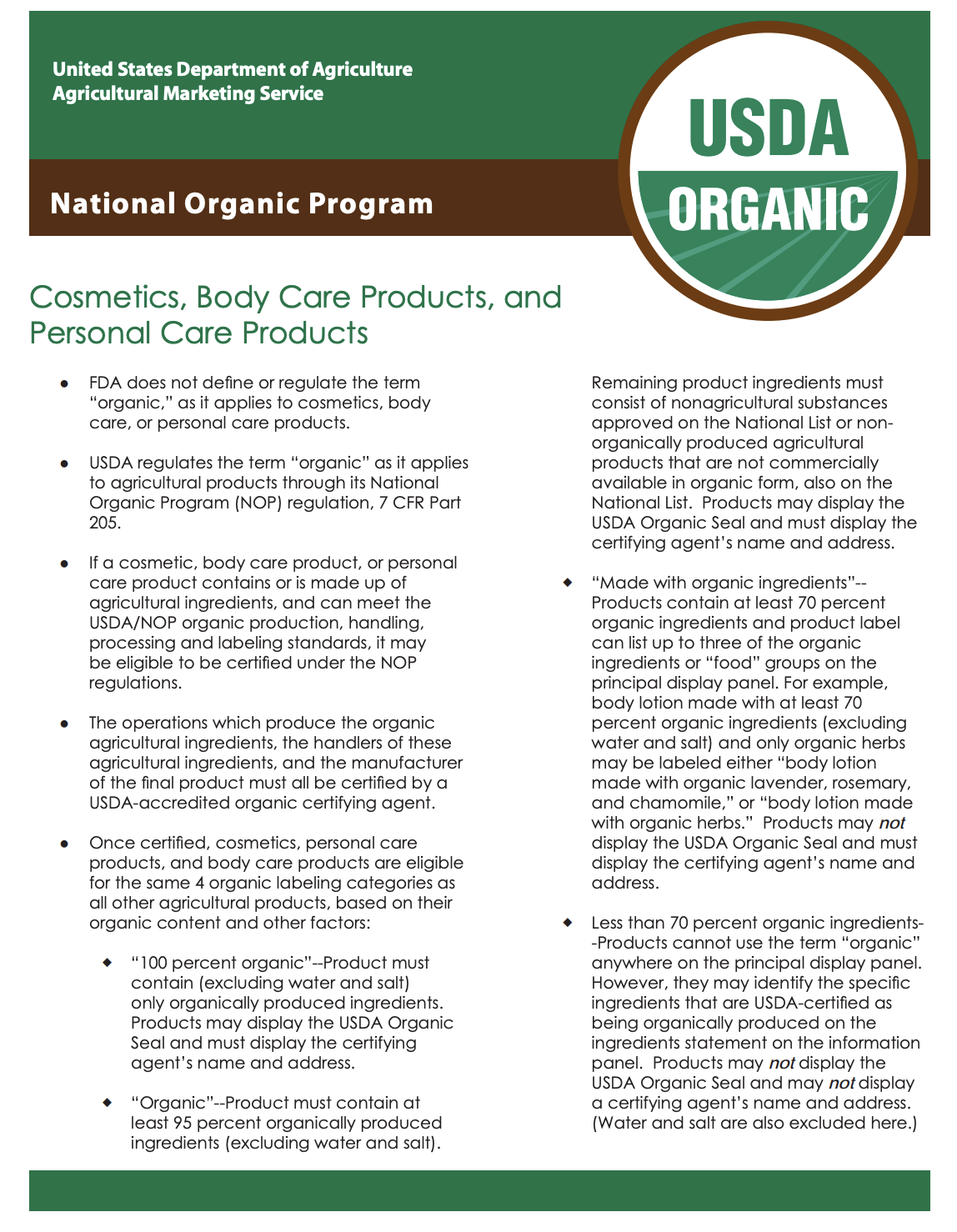
Cosmetics, Body Care Products, andPersonal Care Products
USDA’s National Organic Program (NOP) can certify cosmetics, body-care, and personal-care products only when they contain agricultural ingredients and meet the same organic production, processing, handling, and labeling requirements that apply to other agricultural products. FDA does not define or regulate “organic” for these products.
Q: Can I use the USDA logo on my label?
A: If your product is certified in either the ‘100% organic’ or ‘organic’ categories then you may use the USDA logo if you choose. An electronic version of the USDA logo can be found here https://www.ams.usda.gov/rules-regulations/organic/organic-seal.
Q: Can the USDA logo be displayed in any color that I choose?
A: No. Please refer to the VOF Guidelines booklet or the NOP website (http://www.ams.usda.gov/AMSv1.0/nop)
for specific information pertaining to the use of the USDA logo. There are only three acceptable representations of the USDA logo.
Q: What information is required to identify the handler of a finished product?
A: Handler information identifies the business responsible for manufacturing, packing, or distributing the finished product. Under FDA labeling requirements, the label must include the name and address of the manufacturer, packer, or distributor. If the listed company is not the actual manufacturer, its relationship to the product must be clearly stated with a qualifying phrase, such as “manufactured for” or “distributed by.” The address must include the street address—unless the business is listed in a current city directory or telephone book—along with the city or town, state, and ZIP code..
Q: What is the information panel?
A: The information panel, as defined by the FDA, is the label panel immediately to the right of the principal display panel, as displayed to the consumer. If this panel is not usable, due to package design and construction, (e.g., folded flaps), then the information panel is the next label panel immediately to the right. The information panel is not defined by the placement of the nutritional information and ingredient statement although that information is often found on the information panel.
Q: What is the Principal Display Panel (PDP)?
A: The PDP, as defined by the FDA, is the portion of the package label that is most likely to be seen by the consumer at the time of purchase.
Regenerative Organic Certified™
Regenerative Organic Certified™ builds upon USDA organic certification, using it as a foundation while advancing standards for soil health, animal welfare, and social fairness. Through its bronze, silver, and gold certification levels, ROC™ also promotes continuous improvement, encouraging farms and brands to strengthen regenerative practices over time.
Certification Requirements: Organic certification is the baseline. The standard addresses soil organic matter, biodiversity, cover crops, crop rotation, conservation tillage, no synthetic inputs, no GMOs/gene editing, and no soilless systems. Where animals and workers are involved, it also includes welfare and labor/fairness requirements. New applicants begin at Bronze and are expected to advance over time.
Inspection / Audit Process: Submit an application, parcel maps, organic system plan, current organic certificate, licensing agreement, and a Regenerative Organic System Plan; soil tests are required within the first certification year. The program includes review and verification/audit requirements, and participants renew annually.
Approximate Costs and Timing: One-time farm application fee: $350 for fewer than 5 parcels, $550 for 5+ parcels, and $1,000 for grower groups. Annual grower fees begin at approximately $250 or $500, depending on ROC crop value; other costs may apply for audits, processors, brands, and supply-chain participants. Allow several months for documentation, plan review, soil testing, and audit scheduling; exact timing is operation-specific.
Regenerative Food Labels: What’s Behind the Claim?
This guide examines the fast-growing but inconsistently defined world of regenerative-agriculture labels. It compares crop-focused programs based on three areas: restrictions on synthetic pesticides and fertilizers, requirements for soil-health and integrated pest-management practices, and the strength of their verification and chain-of-custody systems.
The authors find substantial variation among labels. Some provide credible assurance that a finished product was produced with lower agrochemical use; others more convincingly verify on-farm regenerative practices; and some lack sufficiently transparent or rigorous oversight to substantiate either claim. The strongest programs, they conclude, pair clear agrochemical-reduction standards with active soil-building practices and robust independent auditing—information intended to help consumers and institutional or corporate food purchasers make informed choice
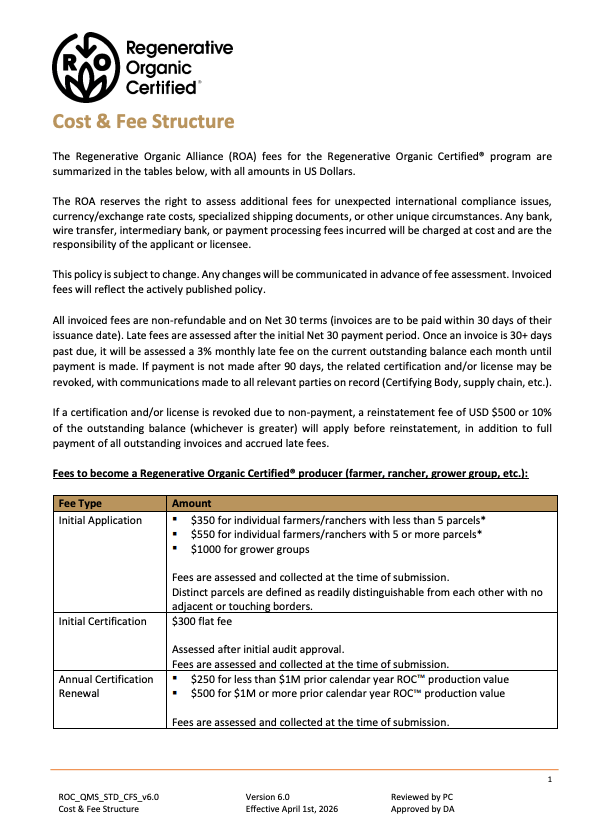
Regenerative Organic Certified Cost & Fee Structure
The Regenerative Organic Alliance (ROA) fees for the Regenerative Organic Certified® program are summarized with all amounts in US Dollars.
Real Organic Project
A farmer-led, voluntary add-on label for USDA-certified organic farms that emphasizes soil-grown crops and pasture-based livestock systems.
Certification Requirements: The farm must already be USDA Certified Organic. Crop standards require soil-based production with a connection to subsoil and prohibit hydroponic production. Livestock standards emphasize daily outdoor access with vegetative cover, pasture-based systems, space for natural behavior, and stronger restrictions on confinement, routine preventive antibiotics, and certain physical alterations.
Inspection / Audit Process: Apply to the program and schedule a growing-season farm visit. New farms receive an initial farm inspection; farms renew annually and are generally revisited every five years. Some organic certifiers coordinate the Real Organic inspection with the organic inspection.
Approximate Costs and Timing: The program reports no fee to participate, and farm visits/inspections are free. The application itself may take roughly 20–30 minutes; initial farm inspections are often about 1–2 hours. Plan around the program’s application deadline and a summer growing-season inspection; the underlying USDA Organic certification still has its own costs and annual inspection cycle.
Animal Welfare Approved by A Greener World (AWA)
A third-party animal-welfare label for independently owned farms raising animals outdoors on pasture or range.
Certification Requirements: Standards require high-welfare management tailored to species, including outdoor/pasture or range access, opportunities for natural behavior, and audited production, transport, and slaughter practices. It is designed for independent farms rather than industrial confinement models.
Inspection / Audit Process: Submit an application and documentation; AGW conducts an independent farm audit, and for meat animals the slaughter plant must also be inspected/audited. Every participating farm receives at least one audit each year.
Approximate Costs and Timing: AWA certification is generally free to farmers; AGW states it offers free certification and support, though confirm whether a particular supply-chain, processing, or service circumstance has a charge. Timing depends on readiness, documentation, auditor availability, and any slaughter-facility review. Expect an initial application-and-audit cycle followed by annual audits.
Certified Regenerative by AGW
A regenerative-farming certification from A Greener World that evaluates soil health, animal welfare, and environmental stewardship.
Certification Requirements: Fhe farm must meet AGW regenerative standards related to soil health, biodiversity, land stewardship, and—when animals are involved—animal welfare. Livestock operations must have at least one species certified to AWA standards within three years, with a plan to certify all applicable species within five years.
Inspection / Audit Process: Submit a regenerative farm plan and supporting materials for review, followed by an audit. Certification requires ongoing audits, generally with costs and scheduling determined per site and travel needs.
Approximate Costs and Timing: Listed initial application and farm-plan review fee: $450. The listed audit/certification fee begins around $800, with travel and operation-specific factors affecting the total; annual audit costs continue after certification. Allow several months for farm-plan development, review, audit scheduling, and corrective actions if needed.
American Grassfed ®️
A certification for meat, dairy, and certain livestock products from animals raised on a 100% grass- and forage-based diet.
Certification Requirements: Producers must meet American Grassfed Association standards for a diet based on grass and forage, with no grain feeding. Requirements also cover pasture-based management and related production, welfare, and recordkeeping expectations.
Inspection / Audit Process: Apply, provide required records and documentation, undergo inspection, submit inspection materials to AGA, receive approval and a label-license agreement, and complete re-inspections every 12–15 months.
Approximate Costs and Timing: Current listed producer costs include $200 annual membership, a one-time $150 licensing fee, plus per-head fees: $1.00 per large ruminant harvested or milked; $0.25 per small ruminant; $0.50 per pastured hog; and $0.01 per pastured poultry bird, with additional conditions for poultry. Budget several months for application, inspection scheduling, review, and label approval; recertification/reinspection occurs every 12–15 months.
Non-GMO Project Verified
A voluntary, third-party verification that a product meets the Non-GMO Project Standard for evaluating and managing GMO risk. It is not a substitute for organic certification.
Certification Requirements: Product formulations, ingredients, supplier documentation, traceability systems, and handling controls are reviewed. High-risk ingredients—such as corn or soy—may need added evidence, testing, and segregation/traceability safeguards. Animal-derived products may require feed documentation and testing when feed includes high-risk ingredients.
Inspection / Audit Process: Choose one of the Non-GMO Project’s approved technical administrators; sign the technical-administrator contract and Non-GMO Project license; complete document review, risk assessment, and audit. Many products receive desk audits; on-site audits are usually needed when high-risk ingredients are handled in parallel. Products undergo annual renewal review.
Approximate Costs and Timing: The Non-GMO Project lists a $115 verification fee for most products as of August 1, 2025; eligible retail-seed products may be $35 and certain meat products may be $50. Technical administrators set their own additional service fees, so total cost depends on products, facilities, ingredients, documentation, and testing. Average completion time is 3–6 months, though lower-risk products can move more quickly.